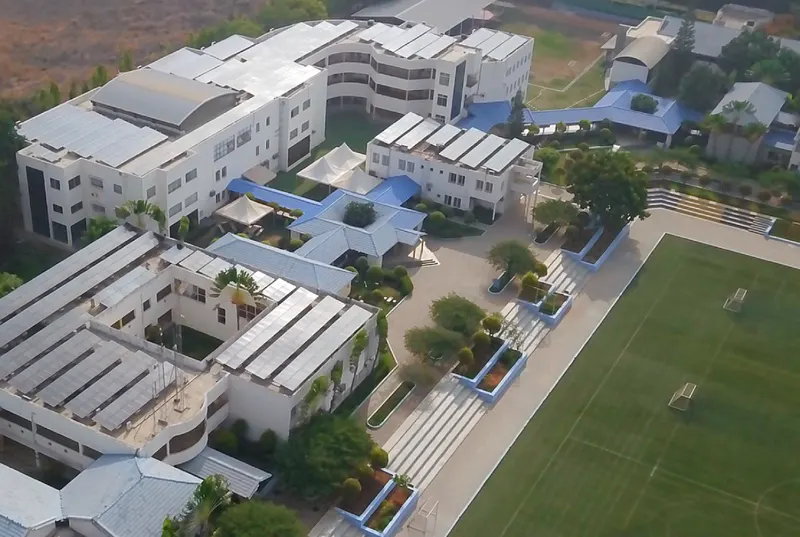
Bangalore's international school market is large, IB-heavy, and very good at the top end. The bigger question for most families is not which school but where in the city you live, because traffic, not distance, is the real constraint.
The city
Bangalore is India's tech capital and the country's most concentrated expat hub outside Mumbai and Delhi. The economy is built on global capability centres, software services, deep tech and life sciences, which is why so many families arrive on a corporate package tied to Manyata Tech Park (north), Outer Ring Road (east), Whitefield, Electronic City (south) or one of the central CBD buildings. The climate is benign by Indian standards: daytime temperatures sit in the 20s to low 30s for most of the year, with monsoon rains from June to September and a pleasant cool stretch from November to February.
The dominant fact of daily life is traffic. Distances on a map are misleading. A 12 kilometre commute from Indiranagar to Sarjapur Road can take anywhere from 25 minutes off-peak to over 90 minutes in monsoon rush hour. The metro is expanding (the Purple and Green lines now cover much of the central spine, with the Blue Line to the airport due to open in stages through 2026), but for school runs and most office commutes, you are still in a car or a school bus. Plan your housing around the school, not your office.
English is universal in the international and corporate professional world, and most schools, hospitals, supermarkets and apartment complexes operate entirely in English. A few words of Kannada or Hindi help with drivers, building staff and informal services, but you do not need either to function. Setting up the basics (apartment lease, FRRO registration if non-Indian, bank account, school admin, mobile, gas connection) takes longer than you think and a relocation agent earns their fee.
The city has a deep, settled international community, with strong Korean, Japanese, French, German, British, American and pan-African cohorts, plus a very large NRI returning-Indian population. You will not feel isolated. You will, however, spend more time in your immediate neighbourhood than you might expect, because driving across the city for a coffee is rarely worth it.
The schools
The International School Bangalore (TISB)
The International School Bangalore is one of the city's most established international schools, on a large valley campus at NAFL Valley near Dommasandra on the Whitefield-Sarjapur corridor since 1993. It runs Cambridge IGCSE through to the IB Diploma, with around 1,170 students aged 3 to 18. Academic results have been a long-standing strength: the 2025 IB Diploma cohort produced multiple students scoring 45, 44 and 43, well above the global average of around 30. Day and boarding both available, which matters if you are coming on a heavily travelled regional role.
Annual day fees run from approximately INR 5,50,000 at Pre-Primary to INR 11,00,000 for the IB Diploma (USD 6,500 to USD 13,000). Capital fees and the boarding premium are on top.
Indus International School Bangalore
Indus International School Bangalore sits on a 40-acre campus on Sarjapur Road and runs the full IB continuum from PYP through MYP to the Diploma, with day and boarding from age 3 to 18. The school has a long-running reputation in EducationWorld's day-cum-boarding rankings and a campus and sports infrastructure that comfortably matches any school in the country. Around 1,100 students.
Day fees range from INR 5,00,000 at Pre-Primary to INR 12,00,000 at Grade 12 (USD 6,000 to USD 14,000), with a one-time security deposit of INR 50,000 and an INR 7,500 registration fee. Boarding is materially more.
Canadian International School Bangalore
Canadian International School Bangalore is in Yelahanka in north Bangalore and is the only school in the city dual-accredited by the Council of International Schools and the New England Association of Schools and Colleges. It runs Cambridge Primary and IGCSE alongside the IB Diploma, with around 700 students aged 3 to 18. The campus is purpose-built and the location works well for families based around Hebbal, Yelahanka and the airport corridor.
Day fees run from INR 5,41,700 to INR 11,22,700 per year (USD 6,500 to USD 13,500), with a USD 200 application fee for Grades 3 and above.
Stonehill International School
Stonehill International School is the other strong north Bangalore IB option, on a 34-acre campus at Tarahunise in Jala Hobli, close to Kempegowda International Airport. Founded in 2008, it offers the full IB continuum (PYP, MYP, Diploma and the Career-related Programme), with around 600 students. The school reports that 87% of recent graduates received offers from top-100 universities, with destinations including Stanford, NUS and Cambridge. The campus is calm, green, and a meaningful distance out of the city, which is a plus for families happy to live in the airport corridor and a stretch for anyone working further south.
Day fees run from INR 5,81,090 at KG to INR 12,67,100 for the IB Diploma (USD 7,000 to USD 15,000).
Oakridge International School Bangalore
Oakridge International School Bangalore is a Nord Anglia school on Varthur Road near Dommasandra Circle, on the eastern edge of Bangalore. It runs the full IB continuum from Pre-Nursery to Grade 12 on an 11-acre campus, with around 800 students. The Nord Anglia network brings the MIT and UNICEF collaborations and a structured global mobility offer for families likely to move again, which is a real consideration in this city given the high turnover of corporate postings.
Annual fees run from approximately INR 3,60,000 at Nursery to INR 11,80,000 at Grade 12 (USD 4,300 to USD 14,000).
Greenwood High International School
Greenwood High International School is one of the largest international schools in the city, with more than 2,000 students across an IGCSE, IB Diploma, ICSE and ISC offer on its Sarjapur Road campus near Heggondahalli. Day-and-boarding option. Greenwood has been a consistent top performer in EducationWorld's Karnataka tables for ICSE and international schools, and it is the closest thing in Bangalore to a high-volume school with a strong academic record across multiple curricula. Worth a look if you want IGCSE or ICSE flexibility rather than a pure IB pathway.
International campus fees run from approximately INR 3,00,000 at lower school to INR 9,25,000 for IGCSE boarding (USD 3,600 to USD 11,000).
Inventure Academy
Inventure Academy is on a 37-acre campus near Dommasandra on the Whitefield-Sarjapur corridor and runs Cambridge IGCSE and A/AS Level alongside ICSE and ISC, with around 1,250 students aged 3 to 18. EducationWorld ranked it the number one co-educational day school in India for 2024-25, and it is consistently among the strongest schools in the city for parents who want a Cambridge or ICSE pathway rather than the IB. Note that the published fee schedule includes a 10% annual escalator, which is standard for many Bangalore schools but worth modelling explicitly.
Annual fees run from INR 4,33,000 at Pre-K to INR 10,01,000 at A/AS Level (USD 5,200 to USD 12,000).
Mallya Aditi International School
Mallya Aditi International School in Yelahanka New Town is one of the city's longest-running independent schools, founded in 1984 by the not-for-profit Ujwal Trust. It runs Cambridge IGCSE, A Level and AICE alongside ICSE, with around 740 students aged 6 to 18. The school is dual-accredited by CISCE and Cambridge, runs an AP Testing Centre, and reports that 100% of graduates progress to university. It has a quieter, more academic feel than the larger campus schools, and the not-for-profit governance shows in the way the place is run.
Annual fees run from approximately INR 6,05,000 for ICSE to INR 8,50,000 for IGCSE (USD 7,200 to USD 10,200).
Neev Academy
Neev Academy is on a 16-acre campus in Yemalur, off HAL Airport Road, and runs the full IB continuum (PYP, MYP, Diploma) plus an ICSE option for middle school. NEASC accredited. The school has a strong literacy culture (the Neev Literature Festival is a serious annual fixture) and an Indian arts programme alongside the international curriculum, which families looking for a less generic global-curriculum feel often appreciate. Around 8 to 18 in age range, with the early years grades fed by a separate Indiranagar campus.
Annual fees range from INR 5,50,000 for Grades 1-5 to INR 8,25,000 for the IB Diploma (USD 6,500 to USD 10,000).
A note on the Cambridge and ICSE-only schools
Several Bangalore schools sit just outside the international IB cohort but are credible academic options for families happy with Cambridge or ICSE. Vidyashilp Academy in Yelahanka is a long-established North Bangalore option for ICSE and IGCSE, with around 2,000 students. Bangalore International School in Hennur Gardens is one of India's oldest international schools and offers Cambridge IGCSE, A/AS and the IB Diploma at fees materially below the headline schools. These are worth a look if budget is tighter or if your child is not on a pure-IB pathway.
IB results in context
The global IB Diploma average in 2025 was 30.5. Several Bangalore schools are well above that, and a small number consistently produce 45-point students at the top end, which puts the city in the same conversation as Singapore, Hong Kong and Mumbai for elite IB outcomes.
| School |
2025 IB outcome (where published) |
| The International School Bangalore |
Multiple 45/44/43 scorers |
| Stonehill International School |
87% of graduates to top-100 universities |
| Indus International School Bangalore |
Long-running EducationWorld day-boarding ranking |
| Greenwood High International School |
Consistently above the global IB average |
Schools publish results in different formats year to year. Cohort sizes vary. Compare like for like before drawing conclusions, and ask schools directly for the median Diploma score, the percentage of students above 40, and the failure rate. Those three numbers tell you more than a press-release headline.
Where people live
Three school clusters, three residential clusters. Pick the cluster, then the school, then the housing in that order. Trying to do it the other way round is how families end up in 90-minute school runs.
North Bangalore (Yelahanka, Hebbal, Devanahalli, Sahakar Nagar)
The north cluster has Canadian International School, Stonehill, Mallya Aditi and Trio World Academy, plus access to the airport via the Bellary Road corridor. Hebbal sits at the junction of the Outer Ring Road and the airport road and is the most popular family base in the north. Yelahanka is greener and more spread out. Devanahalli is closer to the airport and Stonehill but feels distinctly suburban. A three or four-bedroom apartment in a serviced gated community in Hebbal typically rents for INR 1,00,000 to INR 2,50,000 per month (USD 1,200 to USD 3,000). Independent villas in Yelahanka can run higher. Manyata Tech Park is here, which is why a lot of corporate-package families anchor in the north.
East Bangalore (Whitefield, Marathahalli, Brookefield)
Whitefield is the original eastern tech hub and still the largest expat residential cluster in the city. The corridor between ITPL and Brookefield is dense with international-grade apartment complexes (Palm Meadows, Prestige Lakeside Habitat, Adarsh Palm Retreat and similar), and the supermarkets, restaurants and clinics catering to international families are concentrated here. The schools accessible from Whitefield include Inventure, TISB, Greenwood High and Oakridge, all on the Sarjapur side of the corridor. A four-bedroom villa in a gated community typically runs INR 1,50,000 to INR 3,50,000 per month (USD 1,800 to USD 4,200), with smaller apartments below that. Whitefield is the easiest soft landing for families coming in on a corporate package and not yet sure where they want to be.
Sarjapur Road and the southern east (Sarjapur, Bellandur, HSR Layout)
Sarjapur Road is the second tech corridor and where many of the strongest schools physically sit. If your school is Indus, Greenwood High, Oakridge, Inventure or TISB, living in the Sarjapur or Bellandur stretch usually beats Whitefield on commute. HSR Layout is closer to the city, popular with younger expat professionals and dual-career couples, and well placed for the Sarjapur schools without committing to an outer suburb. A typical apartment runs INR 80,000 to INR 2,00,000 per month (USD 950 to USD 2,400) depending on layout and complex.
Central east (Indiranagar, Koramangala, Domlur)
Indiranagar and Koramangala are the most cosmopolitan parts of the city, with the best restaurant and bar scene, the most walkable streets, and a settled mix of expat and Indian professional residents. Neev Academy in Yemalur is the natural school anchor here, and several smaller bilingual and Cambridge schools have a presence too. Rents are punchy: a three-bedroom apartment in central Indiranagar runs INR 1,50,000 to INR 3,50,000 per month (USD 1,800 to USD 4,200), and the desirable independent houses materially more.
South Bangalore (Bannerghatta, JP Nagar, Electronic City)
Bannerghatta Road and Electronic City form the southern cluster, with Candor International School, Ebenezer International, Treamis and others in the catchment. Electronic City is heavily corporate (Infosys, Wipro and similar all have major campuses here) and the housing is good value for the spec, but it is a meaningful distance from the central east hubs. JP Nagar is more residential and closer to the city. This is the right cluster if your office is in Electronic City and you do not want to do that commute twice a day.
On the commute question
Bangalore traffic is the dominant constraint on family life here, more than rent, more than school choice, more than weather. A school bus run that looks like 14 kilometres on Google Maps can take 70 minutes each way in monsoon. Most schools run reasonably extensive bus networks, so you do have some flexibility, but a cross-city commute (north to Sarjapur, or Whitefield to south) is rarely sustainable for a child five days a week. If you are picking between two equally good schools and the commute differs by 30 minutes, take the closer one.
Practical notes
Visa and registrationNon-Indian nationals on long-stay visas need to register at the Foreigners Regional Registration Office (FRRO) within 14 days of arrival. The portal is online but the process still takes patience. Schools will normally need a copy of the FRRO registration as part of admission.
HealthcarePrivate healthcare is excellent at the top end and inexpensive by international standards. Manipal Hospital, Apollo, Aster CMI and Fortis are the networks most used by international families. Most large employers provide private health insurance; if not, a family policy of around INR 50,000 to INR 1,50,000 per year (USD 600 to USD 1,800) covers most needs. International SOS and Allianz are common corporate top-ups.
Cost of livingBangalore is materially cheaper than Singapore, Hong Kong or Dubai but no longer cheap by Indian standards. A family of four in a serviced gated community, with a car and driver, household help, and private health insurance, should budget around INR 2,50,000 to INR 5,00,000 per month before school fees (USD 3,000 to USD 6,000). Rent is the largest line by some distance.
TransportMost expat families run a car with a driver. Drivers cost roughly INR 25,000 to INR 40,000 per month (USD 300 to USD 480) plus fuel, and they do school runs, grocery runs and weekend trips. Uber and Ola work well in the central east and north. The metro is useful but not yet comprehensive enough to replace a car for family life.
Domestic helpLive-in or live-out cooks, cleaners and nannies are widely available and reasonably priced. Most families have at least a part-time cook and a cleaner, with a nanny if there are young children. Agencies in Indiranagar and Whitefield handle the placement.
Pollution and waterBangalore is notably better than Delhi or Mumbai on air quality, with annual averages typically in the moderate range. Water supply varies by area; gated communities usually have their own treatment plants and tanker arrangements. Worth asking before signing a lease.