JIS and ACS Jakarta represent two fundamentally different philosophies of education, different in culture, pedagogy, student body, geography and price. Families considering both are rare. Families who understand the difference before visiting will save themselves time.
Written by Mia Windsor · Originally published: 24 February 2026 · 6 min read
TL;DR
- JIS is Jakarta's largest and longest-established international school, progressive, American-curriculum, IB Diploma, 2,500+ students from 70+ nationalities across three campuses in South Jakarta. Fees reach $35,916 at high school
- ACS Jakarta is a selective, Methodist, Singaporean-heritage school in East Jakarta, structured, exam-focused, Cambridge IGCSE into IB Diploma, 800+ students who are predominantly Indonesian. Fees top around $19,244 at IBDP level
- JIS offers a modern, inquiry-based education with exceptional breadth of co-curriculars. ACS offers a disciplined, academically rigorous environment with particular strength in STEM
- The teaching cultures are different. JIS is progressive and student-led. ACS is traditional and teacher-directed. Neither is wrong, but they suit different children
- Geography matters: JIS is in South Jakarta where most expats live. ACS is in East Jakarta, near the outer ring road, a long commute from Pondok Indah or Kemang
In this article
- The quick comparison
- What JIS offers
- What ACS Jakarta offers
- The real differences
- Which families suit which school
- FAQs
The Quick Comparison
|
JIS |
ACS Jakarta |
| Founded |
1951 |
1996 (ACS partnership from 2002) |
| Location |
South Jakarta (Cilandak, Pondok Indah, Pattimura) |
East Jakarta (Cipayung) |
| Students |
2,500+ |
800+ |
| Nationalities |
70+ |
Predominantly Indonesian |
| Curriculum |
American + IB Diploma + AP |
Cambridge Primary, IGCSE, IB Diploma |
| Accreditation |
WASC, CIS |
IB World School, Cambridge Centre |
| Religious affiliation |
None |
Methodist |
| Annual fees (high end) |
~$35,916 |
~$19,244 |
| Campus size |
46+ acres across three campuses |
Large single campus |
| Structure |
Non-profit (Yayasan) |
Part of Anglo-Chinese Schools (Singapore) |
What JIS Offers
JIS is the school most expat families in Jakarta hear about first. Founded in 1951 as the Joint Embassy School, it has operated continuously for over 70 years and sits at the top of Jakarta's international school market alongside BSJ and ISJ. It is a non-profit, 100% of revenue goes back into the school.
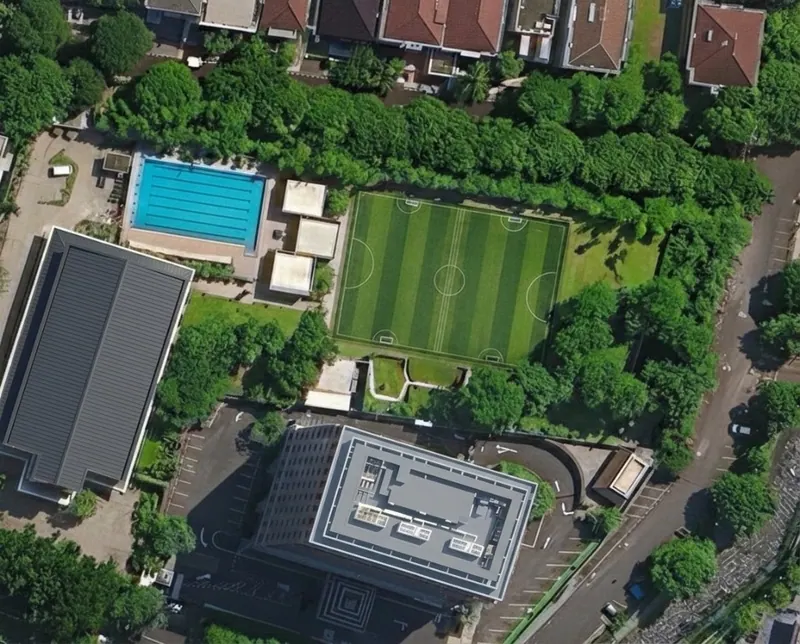
The campus footprint is enormous. Three campuses across South Jakarta totalling over 46 acres, swimming pools, playing fields, theatres, science labs, libraries with 130,000 volumes. Two elementary campuses (Pattimura in Kebayoran Baru and Pondok Indah) and one middle/high school campus in Cilandak, connected by a walking bridge. The facilities are, by any measure, among the best of any school in Southeast Asia.
Academically, JIS runs an American-style curriculum with the IB Diploma and Advanced Placement as senior pathways. The teaching approach is progressive and inquiry-based, students are expected to think, question and create rather than absorb and reproduce. There are 261 teachers, roughly half of whom are US citizens, with the rest drawn from a dozen other countries. The school is accredited by WASC (Western Association of Schools and Colleges) and CIS, and is designated a US State Department-assisted American Overseas School.
The student body is genuinely international, 70+ nationalities, with significant American, Korean, European and Indonesian communities. JIS is a member of IASAS (the Interscholastic Association of Southeast Asian Schools), which means students compete against peer schools across the region in sport, arts and academics. Co-curricular provision is broad: from TEDx conferences to robotics to service programmes through JIS Peduli. The school reports that 99% of graduates go on to university, with recent cohorts placing at institutions including Stanford, Cornell, Boston University, University of Toronto and UBC.
Fees reflect the tier. Full-day Early Years start at $22,333, rising to $35,916 at high school. Add the enrollment guarantee fee, technology fee, and supplementary charges for trips and exams, and the total cost is higher still. This is a school for families on full expatriate packages or with the budget to match.
What ACS Jakarta Offers
ACS Jakarta is a different proposition entirely. It began in 1996 as Sekolah Tiara Bangsa, a national-plus school in Cibubur. In 2002 it partnered with the Anglo-Chinese Schools group in Singapore, a Methodist institution founded in 1886, and in 2006 moved to a purpose-built campus in Cipayung, East Jakarta, formally adopting the ACS name.
The school runs Cambridge Primary through to IGCSE at Grade 10, then the IB Diploma in Grades 11-12. Admissions are selective: prospective students sit entrance tests in English and mathematics, and are interviewed before being accepted. Average class sizes are around 20 students, with a maximum of 24. A full-time Methodist chaplain serves the school, and religion classes are part of the programme.
The culture is structured. ACS comes from a Singaporean educational tradition that values discipline, rigour and measurable academic outcomes. Teachers direct. Students work. Exams matter. If JIS represents the progressive end of international education, inquiry-based, student-led, process-oriented, ACS sits closer to the traditional end: content-rich, teacher-directed, results-focused. Parents who went through Singaporean or East Asian school systems will recognise the approach immediately.
The school has a particular reputation for STEM. One long-term parent noted that "if you are looking for a school that will nurture your child's talent in math and sciences, look no further", while adding that students interested in the arts "might want to look elsewhere." That tension, academic depth in core subjects at the expense of creative breadth, is characteristic of the model.
The student body is predominantly Indonesian, over 800 students, with very few expatriate families. That reflects the school's positioning. ACS Jakarta serves Indonesian families who want an internationally recognised, academically demanding education with clear values and strong discipline. It does that well.
Fees are significantly lower than JIS. Annual tuition plus materials ranges from IDR 262.6 million to IDR 323.8 million (~$15,607-$19,244). ACS offers an early bird discount for prompt payment. Camps are compulsory and cost $700-$1,600 per student per year depending on grade. ACS is also building a second campus at BSD City in South Tangerang, with groundbreaking in November 2024, a significant expansion for a school that has until now operated from a single site.
The Real Differences
The table and profiles above give you the facts. Here is what they mean in practice.
Teaching philosophy. This is the core difference and it shapes everything else. JIS follows a progressive, American-influenced model: inquiry-based learning, student agency, collaborative projects, open-ended assessment. ACS follows a structured, Singaporean-influenced model: explicit instruction, regular testing, content mastery, clear expectations. One school asks students to discover. The other tells them what to learn and checks they have learned it. Both produce university-ready graduates. But the experience of being a student at each is very different.
Student body. JIS is one of the most internationally diverse schools in Asia, 70+ nationalities, a large expat population, and a genuinely intercultural environment. ACS Jakarta's student body is almost entirely Indonesian, with a smaller cohort of East Asian and South Asian families. If your family is looking for a multicultural peer group and English-immersion social life, JIS delivers that. If your family is Indonesian or plans to stay in Jakarta long-term, ACS may feel more familiar.
Geography. JIS campuses sit in the heart of South Jakarta, Pondok Indah, Cilandak, Kebayoran Baru, which is where most expat families live. ACS Jakarta is in Cipayung, East Jakarta, off the outer ring road near Taman Mini. For a family in Pondok Indah or Kemang, the commute to ACS can be 45 minutes to an hour each way. That matters more than most families expect. In Jakarta, where you live and where your children go to school need to be compatible, or the daily commute will shape your family's quality of life more than anything the school itself offers.
Fees. JIS is roughly twice the price of ACS at high school level, $35,916 versus $19,244. That gap buys you larger campuses, more international staff, broader co-curricular provision, and the JIS brand. Whether it buys better academic outcomes depends on what you mean by outcomes. ACS graduates get into top-tier universities, Stanford, Oxford, Imperial College London, NUS. JIS graduates do the same, Cornell, Stanford, UChicago, University of Toronto. Both deliver on the exit qualifications.
Co-curriculars and breadth. JIS has an enormous range, sport, arts, service, student-led organisations, IASAS regional competition. The school invests heavily in the non-academic experience. ACS is leaner here. The arts provision is limited. Sport facilities are good (swimming pools, tennis courts, football fields, gymnasiums) but the programme is not as broad. If your child thrives on variety and choice outside the classroom, JIS is the stronger option. If your child is focused on academics and does not need a wide co-curricular menu, ACS may suit.
Religious identity. ACS is Methodist. There is a full-time chaplain, devotional assemblies, and religion as a subject. Families of any faith can enrol, but the faith identity is present and visible. JIS has no religious affiliation.
Which Families Suit Which School
- You are an expatriate family on a corporate package with the budget for $35,000+ fees
- You want a genuinely international, multicultural environment
- You value progressive, inquiry-based education
- Your child benefits from breadth, arts, sport, service, clubs
- You live in South Jakarta and want a short commute
- You want an American-style school experience with IB Diploma or AP pathways
ACS Jakarta is the better fit if
- You are an Indonesian family (or long-term resident) looking for rigorous, structured academics
- Your child is strong in maths and sciences and you want that nurtured
- You value discipline, clear expectations and traditional pedagogy
- You are comfortable with a Methodist school culture
- You live in East Jakarta or are willing to commute from BSD / Cibubur corridor
- You want internationally recognised exit qualifications at a lower fee point than JIS
Neither school is objectively better. They are designed for different families, different children and different priorities. Visiting both, and watching how students and teachers interact in classrooms, not just in admissions presentations, is the only way to know which one fits.
Ready to explore?