Guangzhou's international school market is smaller and quieter than Shanghai or Beijing, which suits many families down to the ground. Fewer schools to research, less competition for places at the top end, and a city that gets on with things.
The city
The city runs on manufacturing and trade. The Canton Fair brings buyers from across the world twice a year, and the broader Pearl River Delta is still the production heartland of global consumer goods. The corporate population here is accordingly a mix of manufacturing executives, trading company staff, and diplomats, with fewer of the tech and finance families who dominate Shanghai and Beijing's international scene.
That mix shapes the schools. Class sizes at many Guangzhou international schools are smaller than you would find at equivalent institutions in Shanghai. Families here tend to stay longer; the churn rate is lower. Whether that produces tighter communities or simply means schools have less incentive to impress is worth asking on your visit.
The city itself is large, subtropical, and genuinely functional. Air quality has improved over the past decade, though it is still not Hong Kong. Mandarin is the official language but Cantonese is what most locals speak, which means your language app may be less useful than expected for day-to-day interactions. The MTR-linked metro is excellent and covers the key residential and school zones. Pollution peaks in winter; humidity peaks in summer. Everything else is broadly straightforward.
One practical note: most international schools in Guangzhou officially require a foreign passport for enrolment. The rules around Chinese-passport holders have been applied inconsistently over time, and a handful of schools have navigated this in various ways. Verify your child's eligibility before getting attached to any particular school.
The schools
American International School of Guangzhou
American International School of Guangzhou is the most credentialled international school in South China. Forbes ranked it first in South China and Hurun ranked it first in Guangzhou and tenth nationally in 2025. It runs the full IB continuum across two campuses, one in Yuexiu (the main central location) and one in Huangpu (Science City). WASC-accredited. IB Diploma average of 33.7 in 2025, against a global average of 30.5.
The school serves around 1,080 students aged 3 to 18. Fees run USD 32,000-USD 42,000/year (approximately CNY 232,000-CNY 305,000). At that level you are paying a premium, but the results and rankings justify a serious look. The Huangpu campus is newer and serves families in Science City; the Yuexiu campus has deeper roots in the central city.
The British School of Guangzhou
The British School of Guangzhou is a Nord Anglia Education school in Baiyun, taking children from age 1 through to Year 13. The 2024-25 results were strong: 63% A*/A at IGCSE and 62% A/A* at A-Level, both well above the UK national average of around 28% A/A*. The 100% IGCSE pass rate at A*-C rounds things out.
Fees run USD 13,000-USD 40,000/year (approximately CNY 94,000-CNY 290,000), with the lower end covering early years. The Nord Anglia network connection brings access to international partnerships and performing arts programmes with Juilliard and MIT. Whether that matters to you depends on your child and your priorities, but it does give the school a richer co-curricular offer than many standalone institutions in the city.
Utahloy International School Guangzhou
Utahloy International School Guangzhou runs the full IB continuum from age 2 to 18, making it the only fully day-school PYP-MYP-DP provider in Guangzhou (AISG also covers the continuum but across two campuses). The Baiyun campus sits beside Golden Lake, which sounds like a brochure line but is actually a feature families mention when talking about the atmosphere.
Around 700 students from 50-plus nationalities. One reason families choose Utahloy over AISG is the mother tongue support: Chinese, Korean, Japanese, French, German, and Spanish are all available, which matters if your child is not yet strong in English or you want home-language maintenance. The 160-plus ECA list covers most of what a child could want. Fees run USD 18,000-USD 40,000/year (approximately CNY 130,500-CNY 290,000).
ISA Science City International School
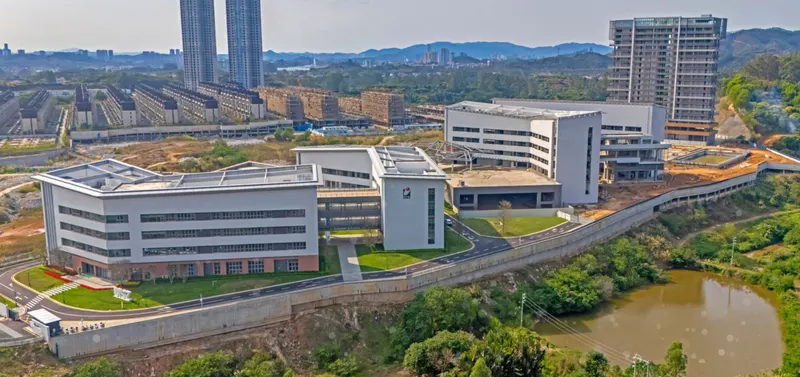
ISA Science City International School is the school families in Huangpu and Science City tend to arrive at first. Purpose-built, opened in 2020, around 2,200 students from age 2 to 18 on the full IB continuum with boarding for up to 500. It holds WELL Gold v2 certification, the only K-12 school in China with that designation at time of writing.
Fees run USD 30,000-USD 45,000/year (approximately CNY 217,500-CNY 326,250). At the top end of the Guangzhou market. The campus is genuinely impressive, and the boarding option is relevant for families with heavy travel schedules or those based in the wider Pearl River Delta outside Guangzhou proper. Families on the school circuit say the teaching quality is strong and the student community feels intentionally built rather than assembled by default.
BASIS International School Guangzhou
BASIS International School Guangzhou is the most academically demanding option in this guide if your child is heading to US universities. The BASIS Curriculum is rigorous by design: the school's own documentation does not shy away from describing it as a high-pressure academic environment. For students who can handle it, the outcomes are real. The Class of 2024 achieved 51% acceptance to US Top 30 universities and USD 1.12 million in scholarships across 267 offers from 47 graduates.
Around 1,200 students from Pre-K through Grade 12 in Science City. Fees run USD 29,000-USD 39,000/year (approximately CNY 210,250-CNY 282,750). Boarding is available, making it one of the few boarding options in this price band. Not the right environment for every child. Worth visiting with an honest assessment of your child's academic drive.
Fettes College Guangzhou
Fettes College Guangzhou is a joint venture between Fettes College in Edinburgh and Country Garden Education, opened in 2020 on a purpose-built campus in Zengcheng. It runs the British curriculum with boarding from age 3 to 18. Forbes put it in the Top 18 International Schools in China. Graduates have reached Oxford and Cambridge in three consecutive years.
Fees run USD 14,000-USD 21,000/year (approximately CNY 101,500-CNY 152,250), which makes it the most affordable genuinely British school in this guide by a considerable margin. Zengcheng is a 45-minute drive from central Tianhe, which puts it on the edge of what most families consider manageable for a daily school run without boarding. Worth factoring that in.
Alcanta International College
Alcanta International College is the outlier in this guide in two respects. It serves students aged 12 to 18 only (Grades 7-12), and it is the only IB-authorised school in Guangzhou permitted to enrol both Chinese and international students. If your child holds a Chinese passport and you want an IB education, Alcanta in Nansha is likely to be the first school you look at seriously.
Around 300 students. Accredited by IBO, Cambridge IGCSE, and MSA-CESS. Graduates have gone to Cambridge, UCL, LSE, Johns Hopkins, NUS, and other leading universities across 12 graduating classes since 2011. Fees run USD 22,000-USD 25,000/year (approximately CNY 159,500-CNY 181,250). Nansha is in the south of the city, well outside the central clusters, so location is the practical question to answer first.
IB results in context
The global IB Diploma average in 2025 was 30.5. Of the schools in this guide that publish Diploma figures, AISG is the headline name:
| School |
IB Diploma average |
| American International School of Guangzhou |
33.7 (2025) |
| Global IB average |
30.5 (2025) |
UISG, ISASC, and Alcanta do not publish headline Diploma averages in the same format. Utahloy posts individual university placement data on its website; ISASC is a newer school and its early cohort data is limited. Ask for Diploma score distributions at any admission meeting rather than settling for headline averages alone.
Where people live
Guangzhou's residential geography for international families sorts into roughly three zones.
Tianhe and Zhujiang New Town
The financial and commercial core of modern Guangzhou. Tianhe is where most of the central international community lives, largely because it is the most liveable part of a city that rewards patience in its older districts. Zhujiang New Town in particular feels clean, walkable, and relatively well served by English-speaking services. Rents for a three-bedroom apartment run approximately CNY 15,000-CNY 25,000/month in this area.
Schools accessible from Tianhe without a lengthy commute include AISG's Yuexiu campus (15-20 minutes), Utahloy and BSG in Baiyun (30-40 minutes), and ISA Liwan in the adjacent Liwan district (20-30 minutes). Most schools run bus services that cover Tianhe.
Yuexiu and Ersha Island
Ersha Island, in the Yuexiu district, is the traditional diplomatic and long-term resident area. It sits on the Pearl River and has a settled, quiet feel that is genuinely different from the pace of Tianhe. Rents are broadly comparable to Tianhe but the housing stock leans toward older, larger apartments rather than modern towers. AISG's main campus in Yuexiu is the natural school for this area.
Panyu and the southern districts
Panyu is where families prioritise space and school proximity over central access. Several of the lower-fee international schools are located here or nearby. Housing is significantly cheaper: three-bedroom apartments run CNY 8,000-CNY 15,000/month, and houses with gardens are available at price points that would buy a small flat in Tianhe. The trade-off is a 40-60 minute commute into central Guangzhou, which most families manage on the metro or by car.
Nansha, further south, is developing fast as part of the Greater Bay Area infrastructure push. Alcanta is the main reason international families end up there; otherwise it is too remote for most school-age families unless your employer is based in the Nansha Free Trade Zone.
Science City (Huangpu)
The fastest-growing cluster. Science City has drawn technology companies and their staff over the past decade, and both AISG Huangpu and ISASC sit here. The residential offer is newer but improving. Families who work in the area find it makes life considerably easier; for everyone else it requires a commitment to a 40-50 minute commute to reach central Tianhe.
Practical notes
Passport and eligibilityMost international schools in Guangzhou require at least one parent to hold a valid work visa (Z visa) or equivalent residency status, and require students to hold a non-Chinese passport. The rules have been enforced more strictly since 2021. Check your specific situation with each school before starting an application.
Admissions timingThe international school population in Guangzhou is smaller than in Shanghai or Beijing, which means the panic-application culture that characterises those cities does not exist here to the same degree. That said, the strongest schools at key entry points (particularly IB Year 1 and IGCSE entry) can reach capacity, and families arriving mid-year for popular year groups should contact schools before a move is confirmed rather than after.
LanguageCantonese is the dominant local language, not Mandarin. Most schools teach Mandarin as part of the curriculum. For day-to-day life outside the international zones, some Cantonese (or a reliable translation app) will serve you better than Mandarin in local shops and restaurants, though Mandarin works in formal settings.
HealthcareClifford Hospital in Panyu and GZ United Family Hospital (previously Guangzhou Liuhua Hospital) are the main English-speaking private healthcare options. Most international health insurance policies cover both. Wait times at United Family are generally short; the facility is smaller than equivalent hospitals in Shanghai but adequate for most needs. For specialist paediatric care, families occasionally go to Hong Kong or Guangzhou Women and Children Medical Centre.
Air qualityThe AQI in Guangzhou is better than Beijing and roughly comparable to Shanghai on most days. PM2.5 spikes occur in winter, particularly November through February, driven partly by regional industrial activity in the Pearl River Delta. Most families in Guangzhou use air purifiers at home and check the AQI before long outdoor activities. It is worth understanding before you arrive rather than discovering afterwards.
Cost of livingOutside school fees, Guangzhou is meaningfully cheaper than Shanghai. A family of four in the central areas, running a car, with private health insurance and eating out regularly, should budget approximately CNY 35,000-CNY 50,000/month before school fees. Food and transport are genuinely cheap. The main expenses are housing in the central zones and the school fees themselves.